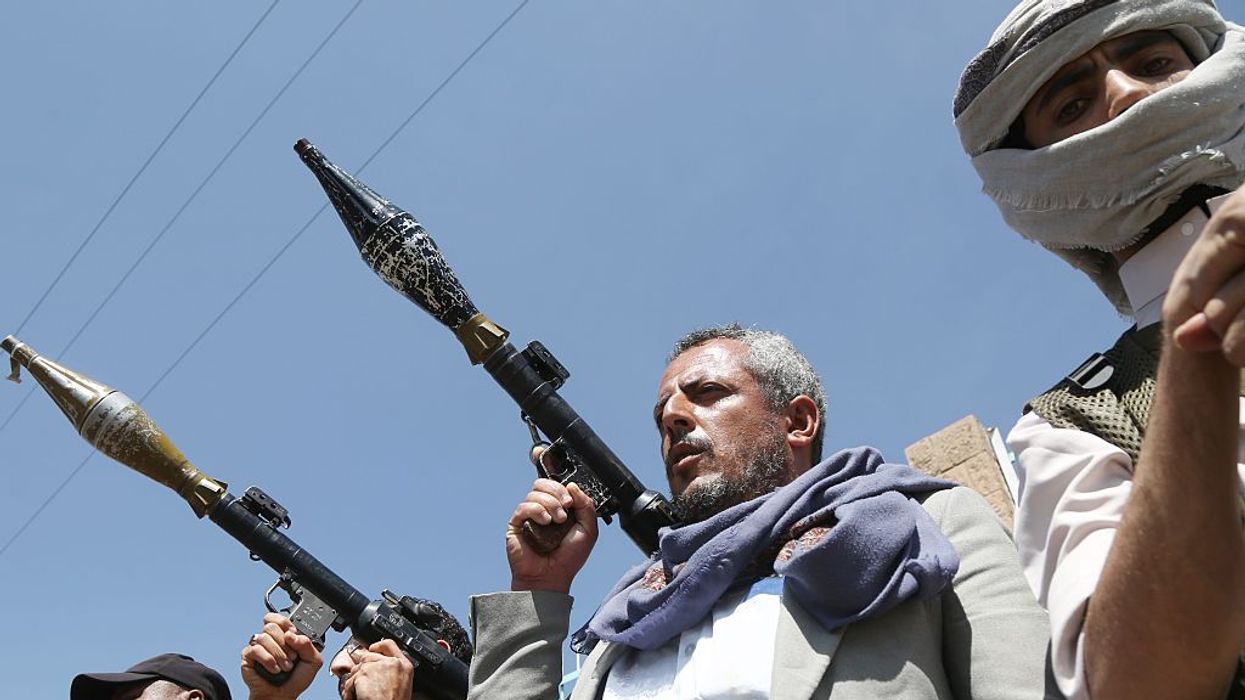
The Iran-aligned Houthi rebels said they launched another strike on Riyadh’s main airport, after earlier attacks on Saudi Arabia killed three and injured 36.
The Houthis said they targeted King Khalid International Airport on Thursday, soon after an attack on the airport killed one person and wounded eight. Saudi Arabia has not confirmed Thursday’s attack. Another two people were killed and 28 wounded in an attack on Abha International Airport, the country’s civil aviation authorities said on Wednesday. The earlier attacks happened on Tuesday and Wednesday, although the authorities did not specify the date of each. The Houthis claimed responsibility for those strikes.
On Thursday, Houthi spokesperson Yahya Saree warned airlines “for the last time” not to continue their flights in Saudi airspace, calling it a “theater” for Houthi military operations.
A Saudi-led coalition said late on Wednesday that the attacks “will not go unpunished.” It said it had destroyed 82 Houthi military sites across Saada, Hodeidah, Jawf, and Marib in Yemen.
The rebel group has carried out a series of attacks on infrastructure in Saudi Arabia since Yemen’s government forces launched a major offensive aimed at recapturing key territory around the Bab el-Mandeb Strait that had been seized by the Houthis. Yemeni forces, supported by Saudi airstrikes, said they had reached Mokha on Monday and driven the Houthis back from the strait, although the Houthis dispute those claims.
The fighting has revived the yearslong civil war in Yemen that created one of the world’s worst humanitarian crises. More than 200,000 people have been displaced since the latest exchange of fire began in June, the International Organization for Migration said on Wednesday. The Saudi-led coalition accuses Iran of arming and funding the Houthis, which both Iran and the rebel group deny.
It has also opened up a new front in the U.S. and Israel’s war against Iran, which began on Feb. 28 with a wave of U.S.-Israeli strikes. The Houthis reportedly received direction from Iran’s Islamic Revolutionary Guard Corps to capture Mokha last month to threaten global shipping and energy flows through another shipping route. The battle over Bab el-Mandeb has become more important amid new attacks on vessels through the Strait of Hormuz in recent weeks, as Iran seeks to re-assert its leverage over Hormuz.
Read More: How the War is Changing the Geography of Iran’s Influence
Attacks on airports
Attacks on airports are a recurrent tactic by the Houthis.
The attack on the Riyadh airport killed a Sudanese national, and injured five Saudi citizens, two Egyptian residents, and a Pakistani resident, Saudi authorities said. The attack on Abha airport killed a Moroccan woman and an Algerian woman, and injured Saudi citizens, a Bangladeshi resident, and a Filipino resident.
Earlier on Wednesday, Yemeni authorities said ballistic missile and drone strikes targeted Aden international airport in Yemen. One missile landed near the runway shortly before a flight from Cairo was scheduled to land, Yemen’s Transport Ministry said. The Houthis acknowledged a missile strike nearby but said their target was a military camp.
The Saudi civilian aviation authorities also said two airports in the kingdom’s south were attacked on Monday evening, injuring three people. The airports, King Abdullah bin Abdulaziz International Airport in Jazan and Najran International Airport, suffered material damage, the authorities announced on Tuesday.
Last month, Saudi Arabia accused the Houthis of attempting an attack on Mecca, calling it a “red line.” The Houthis denied the allegations, as did Iran.
War widens
Saudi Arabia has sought help from a number of its allies to fight the Houthis. Turkey has sent defensive and technical support, Reuters reported on Wednesday, citing officials. Saudi Arabia signed the Mecca Joint Defence Agreement with Turkey and Pakistan in August, and the three parties agreed to implement its collective defence commitments earlier this week.
Syria, another Saudi ally, is also weighing providing military aid, Reuters reported, which could include defensive aid or deploying forces on the ground to support the Yemeni offensive against the Houthis. The Syrian foreign ministry did not confirm any potential plan to Reuters and said, “Should Saudi Arabia request any military cooperation or exchange of expertise, this would take place exclusively through official channels and within the framework of the bilateral agreements governing relations between our two brotherly countries.”
Saudi Arabia also reportedly requested assistance from the U.S., although President Donald Trump has thus far declined requests for direct U.S. strikes against the Houthis. The U.S. has instead provided the kingdom with intelligence support.
Tanker attacks in Hormuz
Although Middle East oil exports have ticked up in recent weeks, renewed attacks on vessels near the Strait of Hormuz have raised the stakes at Bab El-Mandeb, which became a critical alternative route for Saudi oil exports earlier in the Iran War.
Last week, attacks on tankers in the Strait of Hormuz hit their highest weekly level since the Iran War began. There were at least 12 attacks on oil, LNG, and LPG tankers near the Strait of Hormuz between Sept. 28 and Oct. 5, Reuters reported, citing data from three maritime security sources.
Attacks have continued this week.
India’s foreign ministry reported on Tuesday that 12 crew members were injured after an unknown projectile struck a Panama-flagged oil tanker sailing through Hormuz off the coast of Oman.
An unidentified tanker was also struck by multiple projectiles off the northern coast of Qatar on Wednesday, marking a rare attack deep inside the Persian Gulf. The attack resulted in an unknown number of casualties, the U.K. Maritime Trade Operations (UKMTO) said. Authorities launched an investigation into the incident. No one has claimed responsibility for the attack.
Iran said on Wednesday that it would close “illegal” routes that have been used to bypass Tehran’s blockade in the Strait of Hormuz, including a southern route close to Oman’s coast.
“The Strait of Hormuz is closed, and the armed forces of the Islamic Republic of Iran have full control over it,” Mohammadreza Naqdi, an adviser to the Revolutionary Guards’ Commander, told the IRGC-linked Fars news agency.
Naqdi said the “few routes” circumventing Tehran’s blockade were created by blowing up rocky passages in the Strait. He said the routes were used by “small boats smuggling oil and transferring it to tankers.”
Despite Naqdi’s claims, Middle Eastern crude exports exceeded pre-war levels on 14 days in September, according to maritime analytics firm Kpler, which included shipments via Hormuz, the Red Sea, and other routes. U.S. Secretary of State Marco Rubio said Wednesday that Iran had “lost complete control of the Strait” as the U.S. Navy continues escorting some vessels through the Strait.
“There’s almost as much oil flowing out now as there was before this conflict began,” he told reporters while on a visit in Athens.
Nevertheless, analysts previously told TIME that increased attacks in the Strait, coupled with the threat to Bab el-Mandeb, could quickly raise shipping costs and disrupt flows. Brent crude again topped $100 a barrel on Wednesday after retreating from nearly $110 a barrel last month.
The White House has also reportedly asked the Pentagon to develop options for strikes on Iran before November’s midterm elections, although no decision has been made. Trump has sought to ease concerns about the war’s economic toll, claiming Iran is holding out in hopes of hurting Republicans in the midterms and predicting that the war will end soon afterward. Strikes before the vote would end a weekslong lull in U.S. attacks on Iran, and could prompt further retaliation from Iran against energy assets and shipping in the Gulf.