




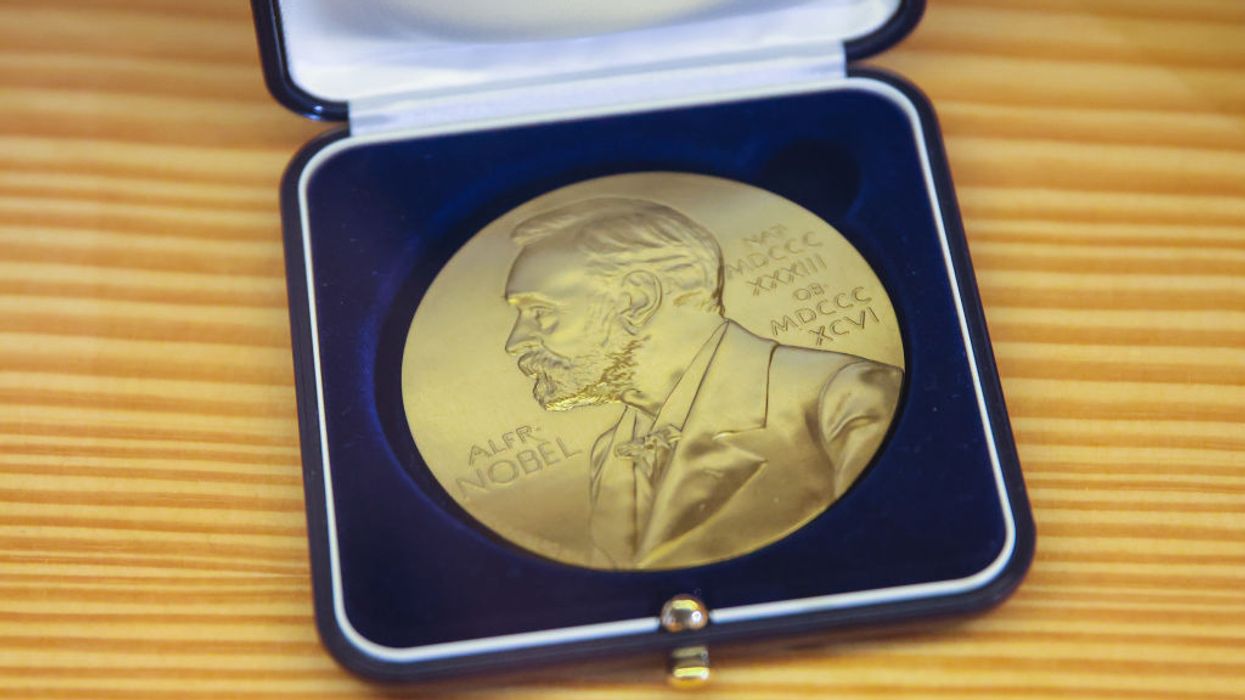
The unveiling of the 2026 Nobel Prizes is now underway.
The Nobel committees have announced the year’s winners in physiology or medicine, physics, and chemistry, honoring scientific contributions that the committees said have “laid the foundation of a new era in neuroscience,” “paved the way for a new kind of astronomy,” and solved a longstanding mystery about the geometry of molecules.
The awards open a week of announcements for the prestigious prizes, which are given each October to individuals or groups for outstanding contributions across six fields: physics, chemistry, physiology or medicine, literature, peace, and economic sciences.
The committees will continue revealing the winner or winners of one category every weekday until the final laureate is announced. The literature prize will be awarded on Thursday; peace on Friday; and economic sciences next Monday, Oct. 12.
Winners will receive a diploma, a medal, and 12 million Swedish kroner—the equivalent of roughly $1.2 million—during the award ceremonies in Stockholm and Oslo in December.
The peace prize, often the most closely watched of the awards, will be given to one of 287 candidates who were nominated this year, the Nobel committee said.
Last year, the honor was awarded to Venezuelan opposition leader María Corina Machado to honor her work fighting against dictatorship and promoting democracy in her country for nearly 25 years. Machado later gave her medal to President Donald Trump, who has long coveted and publicly campaigned for the prize, after the U.S. ousted former Venezuelan President Nicolas Maduro in a military raid in January.
Read More: Meet the 2025 Nobel Prize Winners
The committee, however, issued a statement in the wake of the gesture declaring that laureates cannot share or transfer prizes.
“The decision is final and applies for all time,” the committee wrote.
Trump has again been nominated for the peace prize this year, but is not expected to win the award amid the U.S.’s ongoing war with Iran.
Here’s what to know about the winners who have been announced.
Physiology or medicine
Karl Deisseroth, Peter Hegemann, and Georg Nagel were awarded the Nobel Prize in physiology or medicine on Monday for their pioneering discoveries in optogenetics, a method that uses light to determine how cells operate in the brain or even to exert control over those processes.
“Optogenetics provides opportunities for mapping the brain in a way that we could once only dream of,” said Per Svenningsson, chair of the Nobel Committee for physiology or medicine.
Hegemann is a professor of biophysics at Humboldt University in Berlin. Nagel teaches plant physiology at the University of Wurzburg in Germany. And Deisseroth is a professor of behavioral sciences at Stanford University.
The laureates' use of optogenetics will allow researchers to “discover exactly which of the nerve cells in a complicated bundle control different brain functions,” such as those related to pain, social behavior, thirst and hunger, and reward and attention, the committee wrote.
Nagel said in an interview with the Nobel Institute that he was “very surprised” upon receiving the news and that he thought it was “too early to get this prize in medicine optogenetics,” given his belief that other medical discoveries have benefited a greater number of people. Hegemann said to the institute that he was “overwhelmed” upon receiving the news.
Deisseroth, who has similarly said he was “quite surprised” to receive the honor, told Stanford Medicine that he “couldn’t be happier,” noting that “the trio that the committee picked spans the progression from the early algal explorations all the way to advanced neuroscience experiments.”
“So this prize really captures the full journey of discovery,” he said.
Physics
Francis Halzen was awarded the Nobel Prize in physics on Tuesday for his work studying neutrinos, extremely small, ghostly particles that are all around us but rarely interact with other matter.
Neutrinos carry no electrical charge, allowing them to travel great distances and pass through most matter without losing energy or changing direction. This quality makes the particles potent messengers for information about distant cosmic phenomena. But it also makes them exceedingly hard to detect and study.
Halzen, a professor of physics at the University of Wisconsin-Madison, came up with the idea of using ice at the South Pole to track the elusive particles. His work, the Nobel committees said, has been “fundamental” for the IceCube Neutrino Observatory, which is equipped with thousands of light sensors embedded in the transparent glacial ice that enable researchers to observe and capture the faint flashes of light produced in the rare instances when neutrinos do interact with other particles. Not long after the observatory was completed, IceCube detected the first high-energy neutrinos from far-away galaxies.
“Francis Halzen has led an international team of researchers and engineers who have provided us with a fantastic instrument. His tenacity and scientific vision has paved the way for a new kind of astronomy,” Mark Pearce, Chair of the Nobel Committee for Physics, said in a press release.
Halzen was at a science festival in Bergamo, Italy, working on a proposal when he received the news that he had won the prize. “As I joked in one of the meetings, I hope it helps to get it funded,” he said in an interview with the Nobel Institute.
Halzen explained how his team at IceCube discovered that blue light can travel for hundreds of meters through the ice at the South Pole, which allowed them to observe neutrinos’ interactions. “This is ancient snow that fell on Antarctica 50,000 years ago. It’s ultra pure, and that’s why it’s so transparent,” he explained.
The tracking of neutrinos, Halzen added, may provide insight even in the study of black holes.
“This is obviously a place from which light doesn’t escape,” he said of the cosmic vacuums. But, he noted, the very first time IceCube researchers identified a celestial neutrino source, tracing the particles back to an active galaxy with a supermassive black hole at its center, “is already an example of looking into the very close regions of the black hole, where presumably only neutrinos escape.”
Chemistry
The Nobel Prize in chemistry was awarded to Henri B. Kagan and Kenso Soai on Wednesday for finding the solution to a mystery about the chirality, or “handedness,” of molecules that had confounded scientists for decades.
Many molecules possess two variants that are mirror images of each other, similar to a right and a left hand, But one of those variants heavily predominates when the molecule is found in nature, and is the only variant of the molecule that is found in living beings. And, despite their similarity, each of the variants produces a different effect, meaning that in pharmaceuticals, for instance, only one of the mirror-image versions of the molecule can contribute to the desired result of a drug.
Scientists were long mystified by how to create a particular mirror image, finding that the two variants were produced in equal proportions when they did experiments that formed these “handed” molecules.
It was Kagan, who teaches at the Université Paris-Sud in Orsay, France, and Kenso, who teaches at the Tokyo University of Science, who figured out the process for producing a desired variant, demonstrating how homochirality—or same handedness—occurs in molecules.
“Henri Kagan and Kenso Soai have provided a solution to a chemical mystery that is over a century old: how homochirality can emerge spontaneously. The chemical reactions they have developed are spectacular,” Heiner Linke, chair of the Nobel Committee for Chemistry, said in a press release.
No human had manufactured a chemical reaction that created only one of two possible mirror images of a molecule until Soai succeeded in doing so in 2003. That milestone came after an earlier breakthrough made by Kagan in 1986, when he developed a way of manipulating chemical reactions that enabled him to produce one molecular variant in a notably greater proportion.
Soai and Kagan’s discoveries have contributed to the development of countless drugs and medicines.
“There’s a huge number of drug molecules that are used by incorporating what they have developed,” Peter Somfai, a member of the Nobel Committee for Chemistry, said in an interview. “The left handed version of the drug can have one effect, and the right handed can have one effect.”
“I think many international people in international countries, researchers are attracted to that phenomenon,” Soai said of the reaction he used to produce molecular homochirality in a brief interview with the Nobel Institute. “And so I’m very pleased to know that they are examining our reaction.”